
As explained in Chapter 04.03, the ILO has laid down the fundamental principles and rights at work in 193 Conventions and in the Declaration of 1998. The most important ones are listed and briefly explained below; a detailed overview is the ILO’s «Rules of the Game» (2019). Since these standards are not self-executing, they have to be transformed into national law by the member states that ratify them. There they can be found again – at least in spirit. This is what you check for your country in the exercise at the end of this chapter.
The ten fundamental Conventions
Ten Conventions are «fundamental»: they apply to every member state by the mere fact of membership (s. Chapter 04.03). For each, the Swiss implementation is given as an example of where to look in national law.
| Principle | Fundamental Conventions | Swiss example |
|---|---|---|
| Freedom of association and collective bargaining | No. 87 (1948), No. 98 (1949) | Art. 28 Federal Constitution |
| Elimination of forced labour | No. 29 (1930) with Protocol of 2014, No. 105 (1957) | Art. 182 Criminal Code (human trafficking) |
| Abolition of child labour | No. 138 (1973, minimum age), No. 182 (1999, worst forms) | Art. 30 Labour Act (minimum age 15; no official English translation) |
| Non-discrimination, equal pay | No. 100 (1951), No. 111 (1958) | Art. 8 Federal Constitution, Art. 3 Gender Equality Act |
| Safe and healthy working environment | No. 155 (1981), No. 187 (2006) | Art. 6 Labour Act, Art. 82 Accident Insurance Act (no official English translations) |
Freedom of association
The freedom of association is the right to organise and form employers’ and workers’ organisations; the latter as trade unions. The freedom of association is a fundamental prerequisite for a fair social dialogue among employers or their associations and the trade unions – in particular the collective bargaining – and with the respective government (tripartite).
Collective bargaining
Negotiations between employers or their associations and trade unions representing workers, especially on fair working conditions and wages. Contributes in particular to the prevention of disputes.
Forced labour
Forced labour is all work or service which is exacted from any person under the menace of any penalty, and for which the said person has not offered himself voluntarily. Forced labour is a serious violation of fundamental human rights. It is a leading cause of poverty and a hindrance to economic development. Workers in some countries are still tied to their work through a vicious cycle of debt. An increasing number of women and children are victims of traffickers who sell them into forced prostitution or sweatshops. Forced labour is also imposed as a punishment for expressing one’s political views. The ILO says the elimination of forced labour remains an important challenge for the 21st century.
Child labour
The ILO defines as a child a person under 18 years of age. Child labour is a violation of fundamental human rights. It hinders children’s development, potentially leading to lifelong physical or psychological damage. Child labour perpetuates poverty across generations by keeping the children of the poor out of school and limiting their prospects for upward social mobility.
Equality of opportunity and treatment
The ILO defines discrimination as any distinction, exclusion or preference made on the basis of race, colour, sex, religion, political opinion, national extraction or social origin, which has the effect of nullifying or impairing equality of opportunity or treatment in employment or occupation. Equality of opportunity and treatment is a fundamental human right.
Occupational safety and health
The ILO Constitution sets forth the principle that workers should be protected from sickness, disease and injury arising from their employment. The ILO has adopted more than 40 standards specifically dealing with occupational safety and health, as well as over 40 Codes of Practice. Nearly half of all ILO instruments deal directly or indirectly with occupational safety and health issues. Since 2022, this principle is one of the fundamental ones.
Other important standards
Tripartite consultation (No. 144)
It is the dialogue and cooperation between governments, employers (associations) and workers (represented by trade unions). All three parties take part with the same number of representatives. Tripartite consultations ensure a broad support from all stakeholders.
Labour inspection (No. 81) and labour administration (No. 150)
Labour inspectors examine how national labour standards are applied in the workplace and advise employers and employees on how to improve the application of national law in such matters as working time, wages, occupational safety and health, and child labour. Labour inspection can help prevent problems like occupational accidents, illnesses, absenteeism, abuse of workers and labour conflict and thereby enhance productivity and economic development. National labour administration systems are responsible for the formulation, implementation and supervision of national labour standards.
Employment policy (No. 122) and vocational training (No. 142)
National employment policies promote full, productive and freely chosen employment. Vocational guidance and training is for the ILO an investment in human resources by and of its member states.
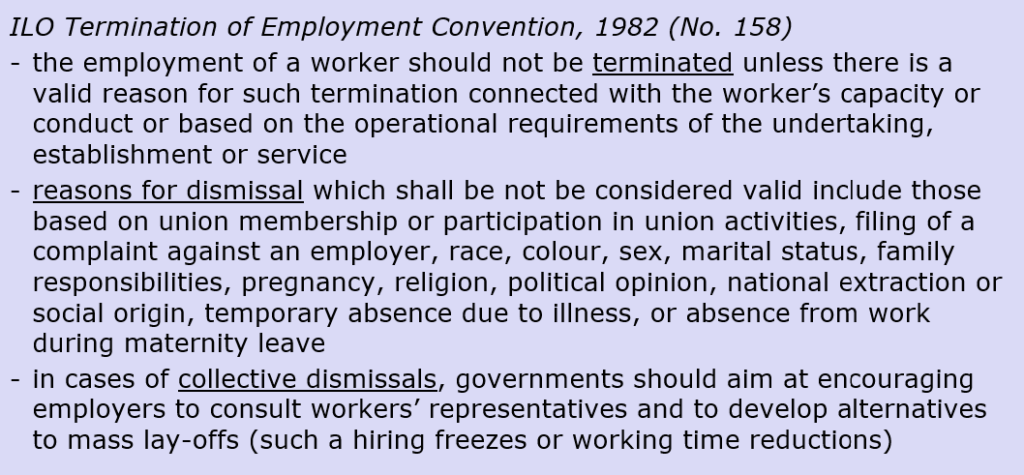
Employment security (No. 158)
ILO standards on termination of employment seek to find a balance between maintaining the employer’s right to dismiss workers for valid reasons and ensuring that such dismissals are fair and are used as a last resort, and that they do not have a disproportionate negative impact on the worker. Swiss example: Art. 336 CO (abusive dismissal).
Wages (No. 95, No. 131 minimum wages, No. 173 insolvency)
The ILO requires regular payment of wages to workers. The member states should define minimum wages. In addition, in the case of employer insolvency, the unpaid wages of employees must be legally secured. Swiss example: Art. 219 Debt Enforcement and Bankruptcy Act (wage claims are privileged) and Art. 51 ff. Unemployment Insurance Act (insolvency compensation); no official English translations.
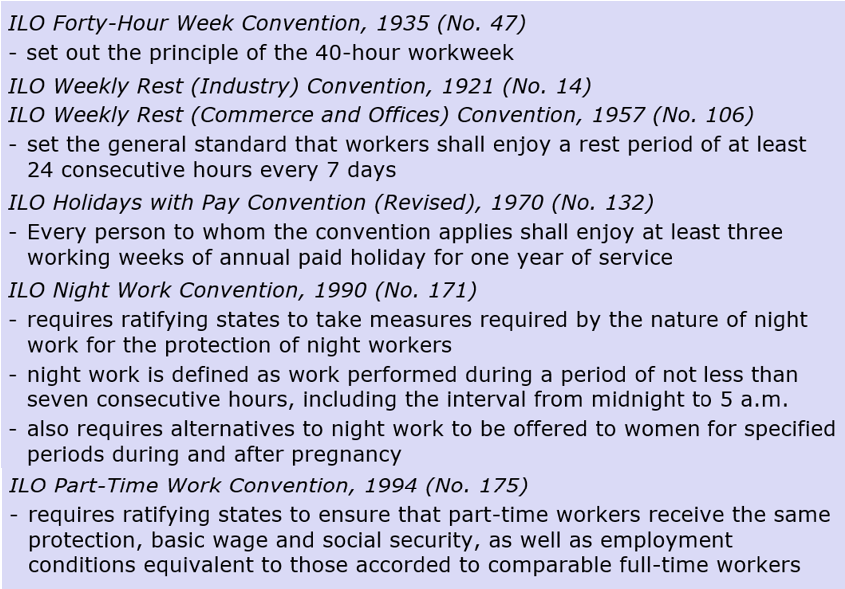
Working time (No. 1 of 1919, No. 14, No. 132 holidays)
Already in the early 19th century, it was recognised that working excessive hours posed a danger to workers’ health and to their families. The very first ILO Convention, adopted in 1919, limited hours of work and provided for adequate rest periods for workers. ILO standards on working time provide the framework for regulated hours of work, daily and weekly rest periods, and annual holidays. Swiss example: Art. 9 Labour Act (45 or 50 hours per week; no official English translation).
Social security (No. 102)
Social security systems provide for a basic income in cases of unemployment, illness and injury, old age and retirement, disability, family responsibilities such as pregnancy and childcare, and loss of the family breadwinner.
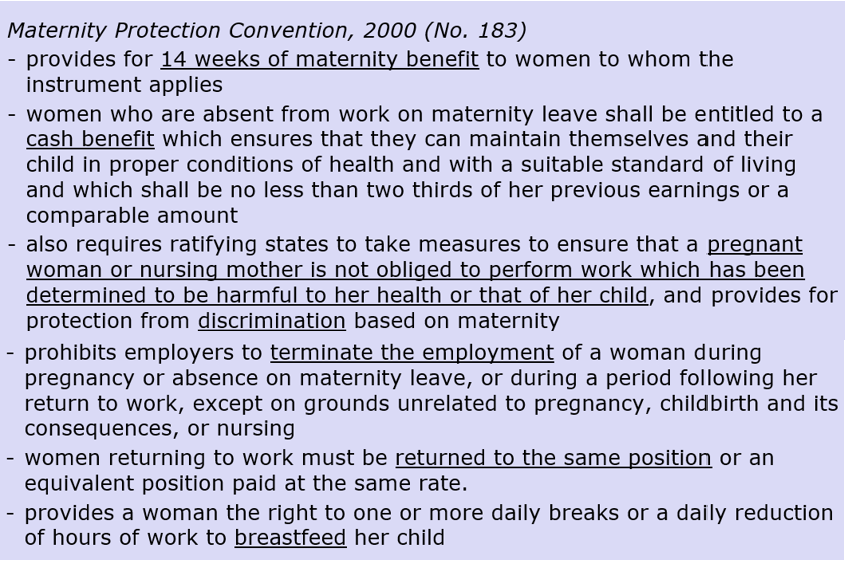
Maternity protection (No. 183)
At least 14 weeks of maternity leave with cash benefits, health protection at work and protection against dismissal during pregnancy and leave. Swiss example: Art. 329f CO (14 weeks of leave) and Art. 336c CO (no dismissal during pregnancy and 16 weeks after birth).
Migrant workers (No. 97, No. 143) and other specific categories
ILO standards on migration provide tools for both migrant-sending and receiving countries to manage migration flows and ensure adequate protection for this vulnerable category of workers. Further standards protect seafarers (Maritime Labour Convention, 2006), fishers, dockworkers and indigenous and tribal peoples (No. 169).
Exercise: the missing two
Switzerland has ratified only 8 of the 10 fundamental Conventions. Ask your AI chatbot which two are missing and why Switzerland has not ratified them. Then verify in NORMLEX. Finally: how many of the ten has your country ratified – and which national laws implement them? Prepare this for the case «ILO principles in your law» (Chapter 04.D).
Source and literature reference: ILO – Rules of the Game – An introduction to the standards-related work of the International Labour Organization (4th edition, 2019).