
Qualified electronic signature
Under Art. 14 para. 2bis CO, a qualified electronic signature (QES) combined with a qualified time stamp in accordance with the Federal Act on Electronic Signatures (ZertES, in German; specifically Art. 2 let. e ZertES) is equivalent to a handwritten signature. Important: this signature is not simply a scanned signature (!), but a purely electronic signature that works, in effect, like the log-in to e-banking. The difference: the log-in to e-banking is an e-identification agreed exclusively for one specific application; it is based on a contract, specifically between the customer and the bank. The QES, by contrast, is universal: with it you can sign anything, for an unlimited number of applications, based on the law. Put simply, the infrastructure behind the QES confirms to the other party that I am who I claim to be. For this, I must first identify myself with the provider of the service. Today the QES is usually created as a remote signature: the signature key is stored securely with the provider, and the signature is released via an app on the smartphone (Face ID, fingerprint or code). Most countries have an equivalent to the QES, for example under the EU’s eIDAS Regulation (see below); the standards and the recognised providers, however, differ from country to country.
Providers of the qualified electronic signature
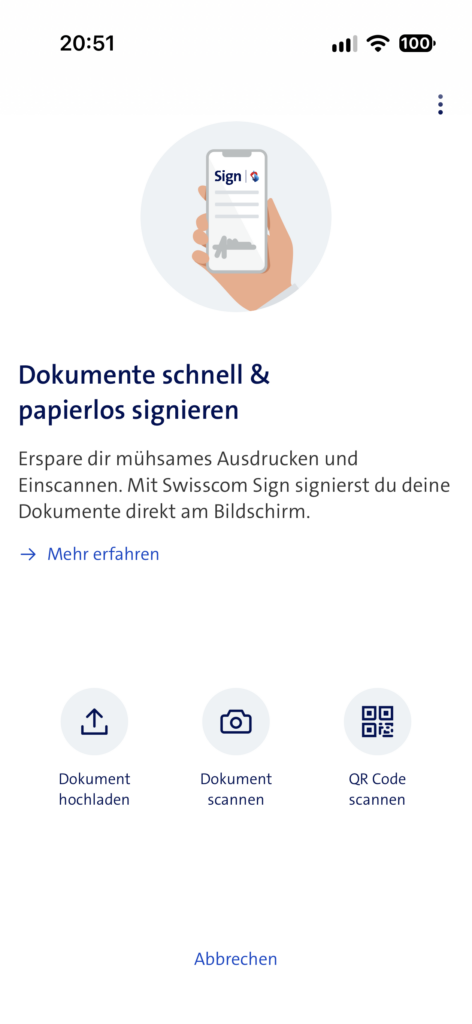
To obtain a QES, you must contact one of the recognised providers (list of providers of certification services recognised under ZertES). At present these are DigiCert Switzerland AG (QuoVadis), SIGN8 AG, Swisscom (Schweiz) AG and SwissSign AG, plus the Federal Office of Information Technology for the federal administration (OFCOM, as of August 2026). All offer comparable solutions; the choice is free. In my case it is Swisscom Sign, because I need the signature for the university and as a lawyer. Registration takes place in the app with a selfie, a photo of the passport page with my picture and a scan of the chip in the passport, without visiting a counter. To sign, I upload a PDF document or scan a paper document, select the QES and release the signature on my smartphone. For private use the service is free of charge; for commercial use a QES with Swisscom Sign costs CHF 2.40 without a subscription. When I send such a signed PDF to a recipient, he or she can click on the signature; a server of the provider confirms that the document was indeed signed by me. In addition, any signed document can be checked free of charge on validator.admin.ch, the validator of the Swiss Confederation.
Possible applications
The possible applications are manifold today: employment, rental and supply contracts, offers, powers of attorney, expense receipts and official forms are signed with a QES, often via platforms that integrate the QES of a recognised provider. As lawyers, we file submissions to the courts via a recognised delivery platform such as IncaMail of Swiss Post or PrivaSphere, signed with a QES (Federal Office of Justice, in German); in future, electronic legal transactions will run via the justice platform justitia.swiss (in German), in the current pilot phase still with QES, after the entry into force of the relevant federal act (planned for 1 July 2027) without (Justitia 4.0, in German). At the university, I sign, for example, agreements with the university or with external partners such as Innosuisse with a QES.
Valid only under Swiss law!
Caution! A QES under Art. 14 para. 2bis CO in conjunction with the ZertES is legally valid only for transactions under Swiss law. Switzerland has no agreement with any state, nor with the EU, on the mutual recognition of electronic signatures; a Swiss QES is not a QES in the EU and vice versa. The Federal Council issued a negotiating mandate with the EU in January 2025; according to OFCOM, an agreement before the end of 2026 is unlikely. In the EU, the eIDAS Regulation applies. As the Swiss company Stadler Rail had to learn, the greatest caution is required when using a QES in other legal systems: in a procurement procedure of the Austrian Federal Railways ÖBB for up to 186 double-decker trains, the Austrian Federal Administrative Court declared the award to Stadler void because the bid had been signed with a Swiss QES, which is not recognised in the EU (SRF, 23 September 2021, in German). Stadler got the contract in the end, but only after a new tender and court proceedings, in February 2022 (ÖBB, 23 February 2022, in German). The practical solution: providers such as Swisscom, which are also recognised under eIDAS, let you choose the legal framework when signing, Switzerland (ZertES) or EU (eIDAS). Rule of thumb: before signing, ask which law governs the document.
QES and e-ID
The QES is a signature, the e-ID an identity document: with the state e-ID you identify yourself online but do not sign anything; the QES remains a service of the private providers (see digilaw.ch, Chapter 05.06 Swiss e-ID, in German; use the translation function).
Check your jurisdiction
Ask a chatbot of your choice (Claude, ChatGPT & Co.): «Which electronic signature is equivalent to a handwritten signature in [my country], who are the recognised providers, and is a Swiss QES or an EU eIDAS signature recognised there? Give me the sources.»
Validate the answer against the statute or the website of the authority in charge of electronic signatures in your country.
In class: we compare your findings and discuss how a Swiss supplier and a customer in your country can sign a contract electronically so that it is valid in both countries.