

Governmental system
Federal republic with direct democracy and a collegial government
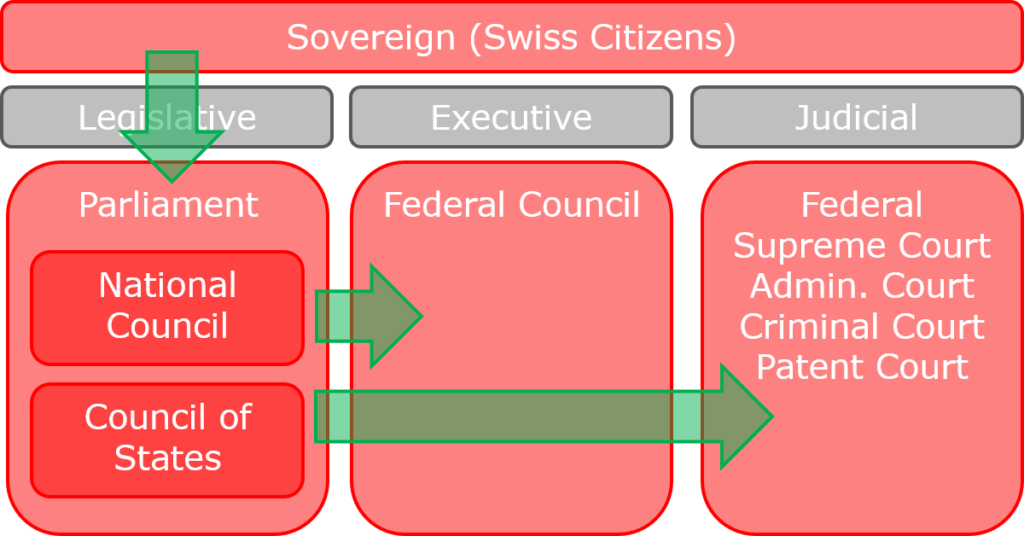
Switzerland is a federal state: the 26 cantons have their own constitutions, parliaments, governments and courts, and they keep every power that the Federal Constitution does not assign to the Confederation (Art. 3). At federal level, the people elect the two chambers of Parliament, the National Council (200 members, representing the people) and the Council of States (46 members, representing the cantons). Parliament is a bicameral system with two chambers of equal powers: a federal act is adopted only if both approve the same text (Art. 156 Federal Constitution). Since every canton has two seats in the Council of States regardless of its population (the six former half-cantons Obwalden, Nidwalden, Basel-Stadt, Basel-Landschaft, Appenzell Ausserrhoden and Appenzell Innerrhoden have one seat each, Art. 150), the small cantons have a strong voice. Parliament elects the Federal Council, the government of seven members who decide as a college and take turns as President for one year, and it elects the federal judges. What makes the system unusual is direct democracy: every federal act can be challenged by referendum, amendments to the Constitution must be approved by the people and the cantons, and citizens can propose such amendments by popular initiative (Art. 138 ff.). Legislation is therefore slow and based on compromise, but unusually stable, which businesses value.
Legal system
Civil law system, codified law; no constitutional review of federal acts
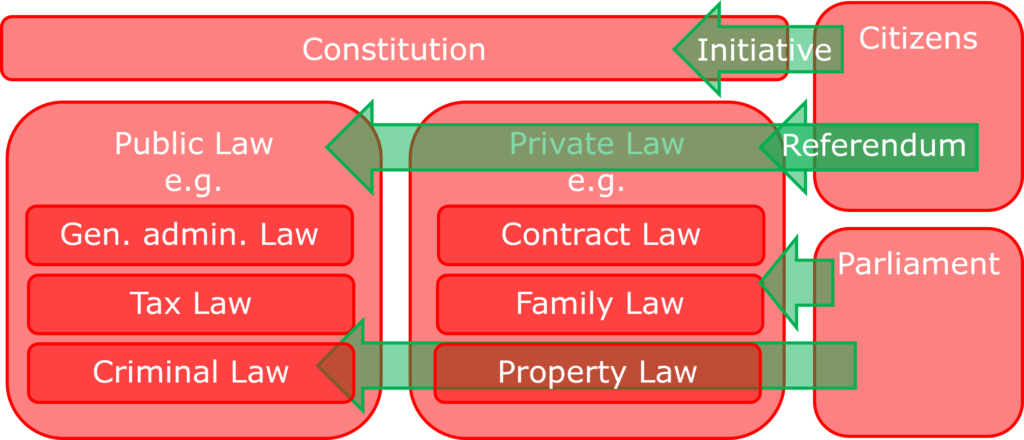
Swiss law is a civil law system: the law is codified in the Federal Constitution, federal acts and ordinances, in particular the Civil Code and the Code of Obligations. Unlike in the USA, private law is federal (Art. 122): contract, company, liability and intellectual property law are governed by federal acts that apply throughout Switzerland; the few remaining areas of cantonal private law (e.g. neighbour law) are of no practical relevance for business. Cantonal public law, however, matters: taxes differ considerably from canton to canton and are an important location factor; building and planning law, business permits (e.g. for restaurants or transport services) and the organisation of the courts of first instance are cantonal as well (with one exception relevant for business: patent disputes are heard exclusively by the Federal Patent Court, as court of first instance). All federal law is published on Fedlex, with English translations of the most important acts. International treaties, once ratified, are part of Swiss law and take precedence over federal acts. The Federal Supreme Court in Lausanne is the highest court; it ensures the uniform application of federal law, but it may not refuse to apply a federal act on the ground that it violates the Constitution (no constitutional review of federal acts, Art. 190); the people, through the referendum, are considered the guardian of the Constitution instead. Cantonal acts, by contrast, can be reviewed against the Constitution.