Partnership – legal entity
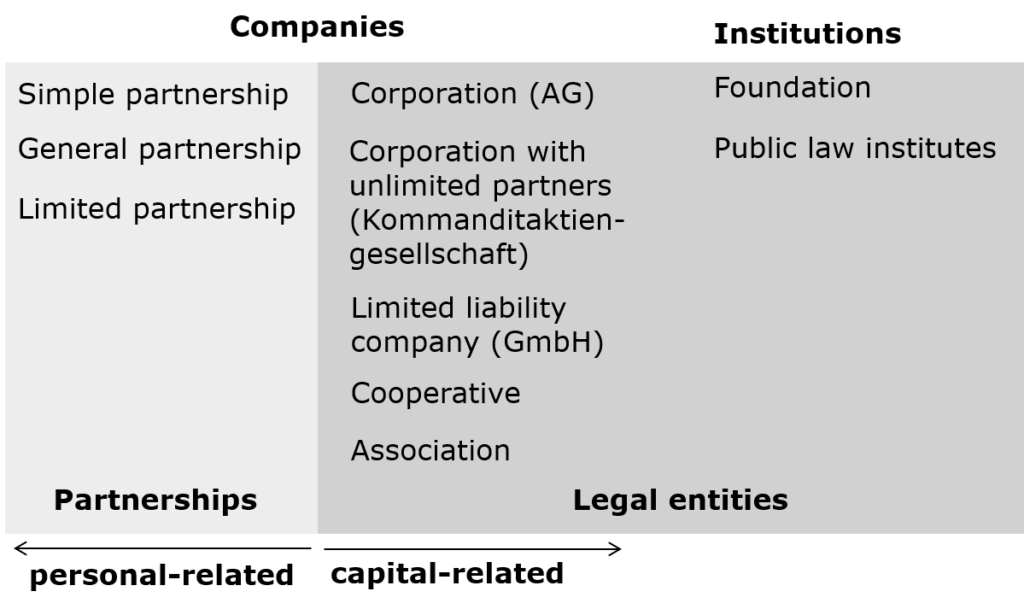
When founding a company, the first step is to decide between a partnership and an independent legal entity. The most significant difference: in a partnership, the individual partners are in principle personally liable to third parties and can be sued personally. A legal entity, on the other hand, has its own legal personality: it can be sued itself, and only its own assets are liable. Because of the personal liability, a partnership is generally not recommended from a legal perspective.
Personal-related – capital-related
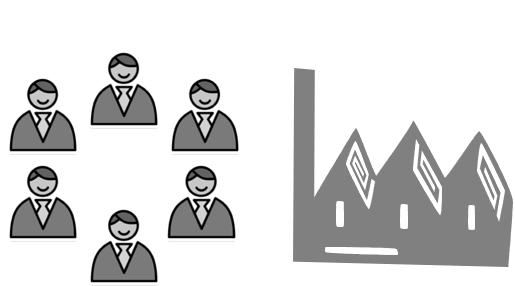
A second distinction is made between personal-related and capital-related companies. In personal-related companies, the partners are personally involved in the business. In capital-related companies, their commitment is entirely or mainly limited to a financial participation. There are also hybrid forms. Examples: the general partnership (CO 552 ff.) is highly personal-related – the partners run the business and are personally liable. In the limited liability company (LLC, CO 772 ff.), the members are usually also involved in the management, but not personally liable. In the corporation (Corp., CO 620 ff.), the shareholders are not involved in the management, and again only the company’s assets are liable. The foundation (CC 80 ff.; s. below) is the strongest capital-related form: an independent asset with no owners at all.
Limiteds
If the liability of the owners is limited to the assets of the company, the company is called a «Limited» or short «Ltd.» – in the UK literally, in other countries by equivalent names (AG/GmbH, Inc./LLC, SA/SARL; see Chapter 06.01). Because of this limitation of liability, the Limited is usually the preferred form of company.
Companies – institutions
Besides companies, Swiss company law knows two institutions: the foundation, which has no owners at all (most pension funds are foundations), and the public-law institution, which belongs to the state – for example Suva, the Swiss accident insurer, or most cantonal banks. Because such institutions play an important role in business, they are also discussed in this chapter.
Graphic overview of the company forms in Switzerland