
Governmental system
Political and economic union of 27 member states with its own institutions and law
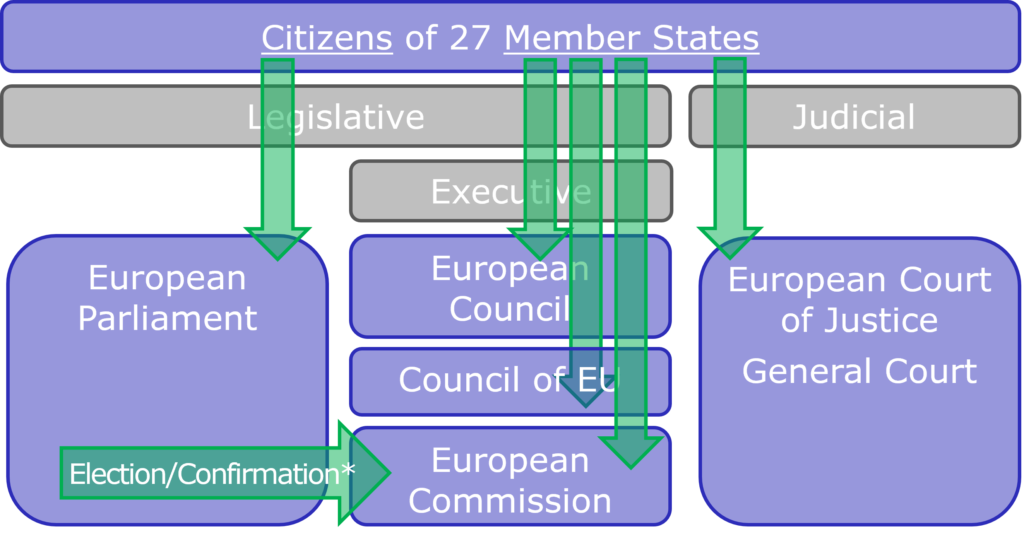
The European Union (EU) is a supranational organisation of its own kind: neither a state nor a classic international organisation. Its member states remain sovereign and are the masters of the treaties, but they have transferred part of their sovereignty to common institutions, which make law that applies directly in all 27 states and takes precedence over national law. The European Parliament (720 members) is elected directly by the citizens. The European Council (heads of state or government) sets the political direction but does not legislate. The Council of the EU (ministers of the member states) adopts legislation together with Parliament. Functionally, this is a bicameral system: Parliament represents the citizens, the Council of the EU the member states, and legislation needs the consent of both. Small states are protected in both chambers: they have more seats in Parliament than their population alone would justify, and in the Council a majority of the states is needed in addition to a majority of the population, so that the large states cannot outvote the small ones (Art. 14 and 16 TEU). Both councils are composed of members of the national governments and are therefore legitimised indirectly, through the national elections; only the European Parliament is elected directly. The European Commission is the executive: it proposes legislation, implements it and, as guardian of the treaties, enforces it against member states and companies (e.g. in competition law). Its President is proposed by the European Council and elected by Parliament, and the Commission as a whole needs the consent of Parliament (Art. 17 TEU). The Court of Justice of the EU in Luxembourg ensures that EU law is interpreted and applied uniformly: the Court of Justice decides on the interpretation of EU law, mostly on referral by national courts; the General Court is the first instance for actions by companies against the EU institutions, for instance against a competition fine imposed by the Commission (Art. 256 TFEU). For business, the EU means above all the single market with its four freedoms (goods, persons, services, capital) and rules that increasingly reach companies outside the EU that sell into it. Switzerland is not a member but is linked to the EU by a network of bilateral agreements.
Legal system
Primary law (treaties) and secondary law (regulations, directives, decisions)
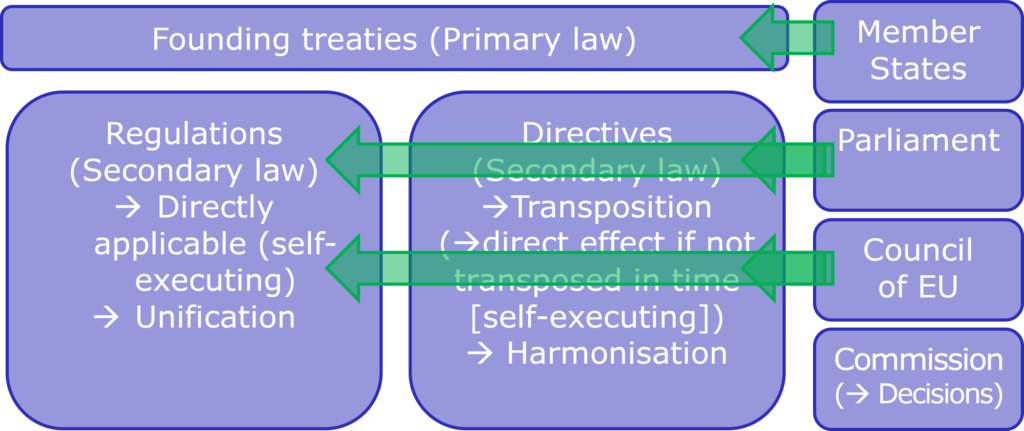
Primary law consists of the founding treaties, today the Treaty on European Union, the Treaty on the Functioning of the EU and the Charter of Fundamental Rights, concluded and amended by the member states. On this basis, the institutions adopt secondary law (Art. 288 TFEU): regulations apply directly in every member state without national implementation (self-executing, see Chapter 01.01) and lead to unification: the same rule in all member states (e.g. the GDPR); directives (/dəˈrektɪvz/ or /daɪˈrektɪvz/; both pronunciations are correct in British and American English, with the stress on the second syllable) set a result that member states must achieve by transposing them into national law within a deadline (non-self-executing) and thus lead to harmonisation: the same result, but through national laws that may differ in detail; if a member state fails to transpose a directive in time, its clear provisions can nevertheless be invoked against that state (direct effect); decisions bind those to whom they are addressed. Regulations and directives are made in the ordinary legislative procedure (Art. 294 TFEU): the Commission proposes, and Parliament and the Council of the EU must both agree on the same text, usually after negotiations between the two (the so-called trilogue, with the Commission as mediator); in the Council, a qualified majority of the member states is normally sufficient, so a single state cannot block a law. Decisions are adopted mainly by the Commission, for example when it fines a company for violating competition law or approves a merger. EU law takes precedence over national law, and the case law of the Court of Justice is a central source. All EU law is published on EUR-Lex in 24 languages. For business, the key point is that regulations such as the GDPR or the AI Act apply directly and also to companies outside the EU that offer goods or services to customers in the EU.
Example: the Whistleblower Directive
The EU Whistleblower Directive protects people who report breaches of EU law. It shows what “binding as to the result” means in practice. The directive only sets minimum standards, and member states may always offer more protection (Art. 25). Each country has made its own choices:
- Scope: Protection may be extended beyond EU law (Art. 2). Germany covers reports of all criminal offences (§ 2 HinSchG). Austria essentially keeps to the areas listed in the directive and adds only corruption offences (§ 3 HSchG).
- Anonymous reports: Each state decides whether companies must accept and follow up anonymous reports (Art. 6).
- Who must set up a reporting channel: This is mandatory for companies with 50 or more workers. States may include smaller companies (Art. 8).
- Authorities and penalties: Each state designates its own reporting authorities and sets its own fines (Art. 11 and Art. 23).
Fixed in all 27 states: protection against retaliation, with the burden of proof on the employer; confidentiality of the whistleblower’s identity; acknowledgement of a report within 7 days and feedback within 3 months.
For business: Groups operating in several EU countries must comply with the strictest national version.