
Governmental system
Federal republic with a presidential system and separation of powers
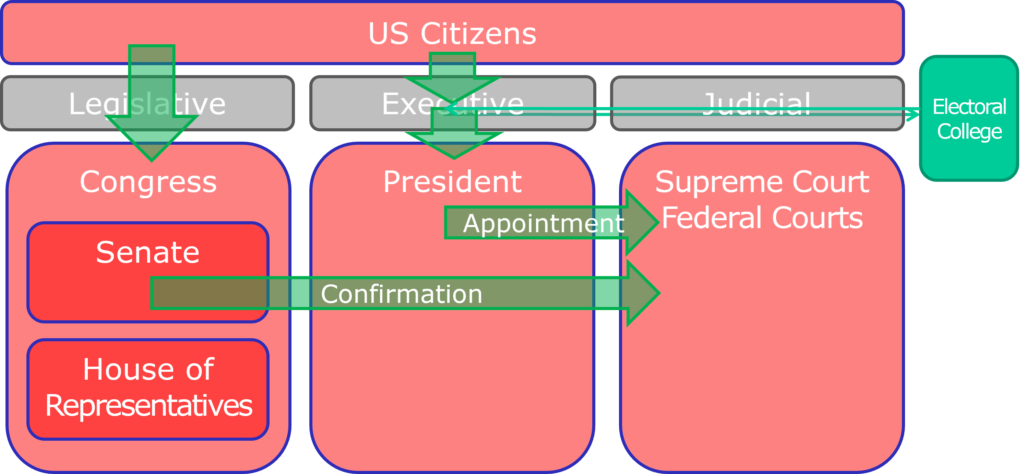
The United States (USA) is a federal republic with a presidential system: the executive, the legislature and the judiciary are elected or appointed separately and check each other (checks and balances). How well these checks work in practice depends on whether Congress and the courts actually use their powers against the President; the current debate in the USA shows that this cannot be taken for granted. The President is head of state and government, elected for four years, not directly by the citizens but by the Electoral College, whose members are chosen state by state (Art. II US Constitution). Like other governments, the President directs the federal administration through instructions, in the USA called executive orders; they bind the administration but rank below the Constitution and federal statutes, and the courts can set them aside if the President exceeds his powers (e.g. the tariffs in Learning Resources v. Trump, 2026). Congress is a bicameral system: the House of Representatives (435 members) represents the people according to population, the Senate the states, with two senators per state regardless of size; a federal law needs the approval of both chambers and the signature of the President, who can veto it (Art. I). The equal representation of the states in the Senate is the strongest protection of small states in the three systems compared here. The justices of the Supreme Court (nine) and the judges of the federal courts are appointed by the President with the confirmation of the Senate, for life (Art. III). The 50 states have their own constitutions, legislatures, governors and courts and, unlike the Swiss cantons, their own private law.
Legal system
Common law system on two levels (federal and state law); judicial review by the courts
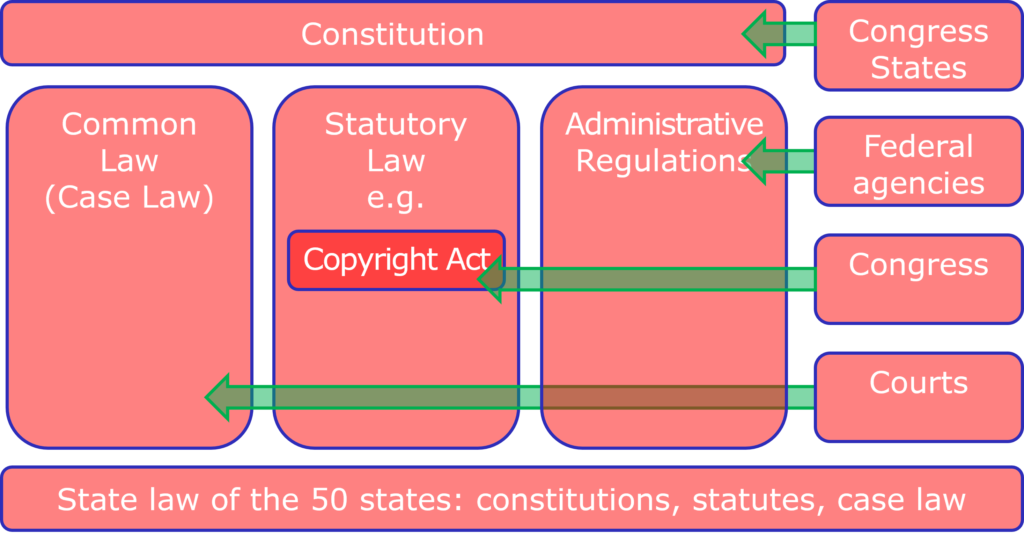
US law is a common law system on two levels. Federal law consists of the Constitution, federal statutes (e.g. on intellectual property, securities and antitrust), the regulations of federal agencies and the case law of the federal courts. State law governs most matters relevant to business: contracts, companies, torts and property are state law and differ from state to state, which is why companies choose their state of incorporation carefully (many in Delaware) and why contracts specify the governing state law. Model laws such as the Uniform Commercial Code, adopted by the states, reduce these differences. There are two court systems side by side, state courts and federal courts, with the Supreme Court at the top for questions of federal law. There is no constitutional court: every court may refuse to apply a law that violates the Constitution (judicial review, established by the Supreme Court in Marbury v. Madison, 1803), and the Supreme Court has the last word. Civil cases are often decided by juries, which, together with high legal costs and large damages awards, shapes the litigation culture that foreign companies must reckon with.